Why the first pull-up is so hard
A pull-up lifts your whole bodyweight with your back, arms and grip. Push-ups and squats let you start with part of your weight. A pull-up doesn’t, so there is no easy version on the bar itself.
That’s why you build up to it from the side: you train the same muscles with exercises you can do today, and make them a little harder each week. Your lats, biceps and grip get stronger, and one day your chin clears the bar.
What you need
- A bar that holds your weight. A doorway pull-up bar, a bar at the playground or the gym all work.
- A low bar or a sturdy table for rows. Check that it can’t tip over before you hang from it.
- Optional: a resistance band. It takes some of your weight off on the bar. Thicker bands help more.
The steps to your first pull-up
Work through these in order. Move on when the current step feels solid, not when it feels easy.
Dead hang
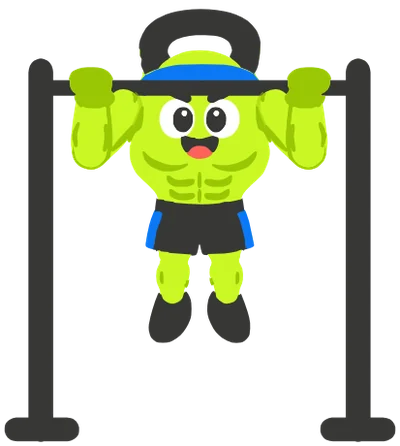
Hang from the bar with straight arms and your shoulders pulled slightly down, not up at your ears. Build up to 30 seconds. This trains your grip, which gives out first for many beginners.
Scapular pull-ups
From a dead hang, pull your shoulder blades down and back without bending your arms. Your body rises a few centimeters. 3 sets of 8 teach you to start every pull-up with your back.
Australian rows
Lie under a low bar or table, hold it and keep your body straight from head to heels. Pull your chest to the bar, then lower slowly. Walk your feet forward to make it harder.
Negative pull-ups
Step or jump up until your chin is over the bar, then lower yourself as slowly as you can. Aim for 3 to 5 seconds at first, later 5 to 10. This is the step that builds the most pull-up strength.
Band-assisted pull-ups
Loop a band over the bar and put a foot or knee in it. Do full pull-ups with its help, and switch to a thinner band as you get stronger.
Your first pull-up
Test once a week at the start of a session, while you’re fresh. Pull from a full hang until your chin is above the bar. No kicking.
A simple 6-week plan
Train three times a week with at least one rest day in between, for example Monday, Wednesday and Friday. Rest 90 seconds to 2 minutes between sets.
| Weeks | Workout |
|---|---|
| 1–2 | Dead hang 3 × 20–30 s · Scapular pull-ups 3 × 8 · Australian rows 3 × 8 |
| 3–4 | Dead hang 3 × 30 s · Australian rows 3 × 10–12, feet further forward · Negatives 3 × 3, 3–5 s down |
| 5–6 | Negatives 4 × 3, 5 s or slower · Band-assisted pull-ups 3 × 5 · Australian rows 3 × 12 · Test one pull-up each week |
Good pull-up form
- Start every rep from a full hang with straight arms.
- Hands a little wider than your shoulders, palms facing away.
- Pull your elbows down toward your ribs, as if you wanted to put them in your back pockets.
- Chin over the bar, then lower all the way down under control.
- Keep your legs still. Swinging moves you up, but it doesn’t make you stronger.
Common mistakes
- Half reps. Stopping halfway up or down trains only half the movement.
- Testing your max every day. Pulling muscles need recovery. Two to four sessions a week are plenty.
- Skipping negatives because they’re hard. They are hard because they work.
- Rushing the band. If the band does most of the work, use a thinner one or go back to negatives.

Let Burly plan it
Burly plans short workouts at your level for home or the gym, shows you every exercise on a loop and raises your targets as soon as you hit them. Add a pull-up bar to your setup, and your pull-ups become part of the plan.
Join the Discord (opens in a new tab)Coming soon to the App Store. Free, for iPhone.
If you have pain, an injury or a health condition, check with a doctor or physiotherapist before you start. Training should feel hard, not painful.